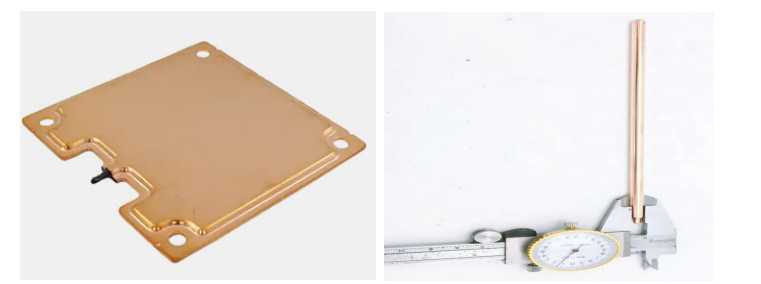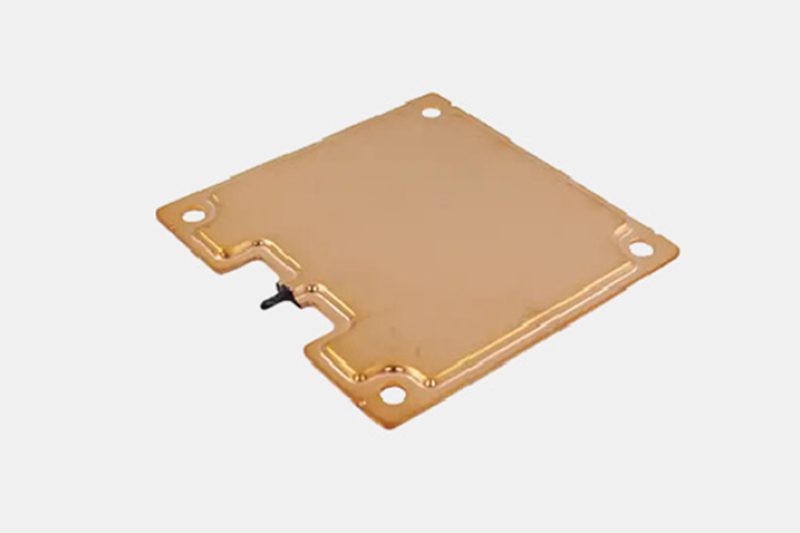
O que são tubos de calor e câmaras de vapor (VCs)? São componentes amplamente utilizados em produtos eletrônicos de alta potência ou alta integração. Quando usados corretamente, podem ser entendidos como componentes com altíssima condutividade térmica. Não é difícil compreender que tubos de calor e VCs podem eliminar eficazmente a resistência térmica por difusão.
Palavras-chave
Tubulação de calor
vapor Chamber
Conteúdo do artigo
The most common application example of heat pipe is embedded in the heat sink, the heat of the chip fully spread on the radiator substrate or fin. When the heat emitted by the chip is transferred to the radiator through the heat-conducting interface material, the heat can be transmitted along the heat pipe with very low thermal resistance due to the high thermal conductivity of the heat pipe. In this case, the heat pipe is connected to the radiator fin, so that the heat can be more effectively dissipated through the radiator into the air. For the heat sink embedded only in the substrate, when the heating area of the chip is relatively small, it is directly transferred to the substrate of the radiator, which will make the temperature distribution of the substrate have a large non-uniformity. After the addition of heat pipes, due to the high thermal conductivity of heat pipes, it can effectively reduce the uneven temperature and improve the heat dissipation efficiency of the heat sink.
Heat pipe and VC have high equivalent thermal conductivity because their internal heat transfer mechanism is phase transformation heat. From the range of surface heat transfer coefficient, it can be seen that the phase transformation heat is the most efficient convective heat transfer. In heat pipe or VC, boiling heat transfer is carried out in the evaporation section, and steam condensation is carried out in the condensation section.
The most important performance indexes of heat pipe and VC are the maximum heat transfer Qmax, thermal resistance R and starting temperature T0. Defined respectively as follows: maximum heat transfer rate Qmax: the calorific value of Qmax value equal to the following situation: heat pipe evaporation or VC joint calorific value of Q fever source, the measured temperature difference between evaporation and condensation within the prescribed scope (usually used in engineering 5 ℃ as decision criteria), the unit is W. thermal resistance R: when heat transfer size of Q, the actual measured the temperature difference between the evaporator and condenser Δ T, thermal resistance value is Δ T/Q, the unit is ℃ / W or K/W.
Starting temperature T0: The heat pipe is a process of evaporation and condensation. But the evaporation and condensation of fluid must occur under certain temperature and pressure conditions. Starting temperature T0 refers to the minimum temperature required for the formation of phase transformation heat cycle in the heat pipe or VC cavity.
There are many factors affecting the performance of heat pipe and VC, and the mechanism analysis needs to clarify the heat transfer process in the cavity. When the evaporation section of the heat pipe is heated, the liquid in the suction core inside the evaporation section evaporates, and the pressure here increases, and the vapor transfers to the condensing section under the action of pressure difference. When the gas is transferred to the condensate section, it is condensed into a liquid. The condensed liquid is transferred to the evaporation section through capillary force in the suction core, forming a cycle. As follows: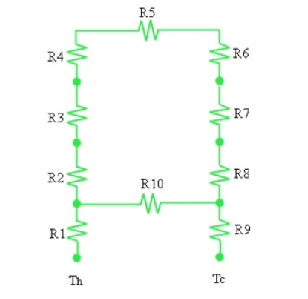
R1: resistência à transferência de calor (convectiva) entre a fonte de calor e a parede externa da seção de evaporação
R2: resistência radial à condução de calor da parede da seção de evaporação.
R3: resistência à condutividade térmica (radial) do núcleo de sucção da seção de evaporação
R4: resistência térmica da troca de calor por evaporação na superfície interna da seção de evaporação
R5: resistência térmica do fluxo axial de vapor
R6: resistência térmica da troca de calor de condensação na superfície interna da seção de condensação
R7: resistência à condutividade térmica do núcleo de sucção da seção de condensação
R8: resistência à condutividade térmica da parede do tubo da seção de condensação
R9: (Convecção) resistência à transferência de calor da superfície da parede externa da fonte fria e seção de condensação R10: resistência térmica axial da parede do tubo e núcleo de sucção